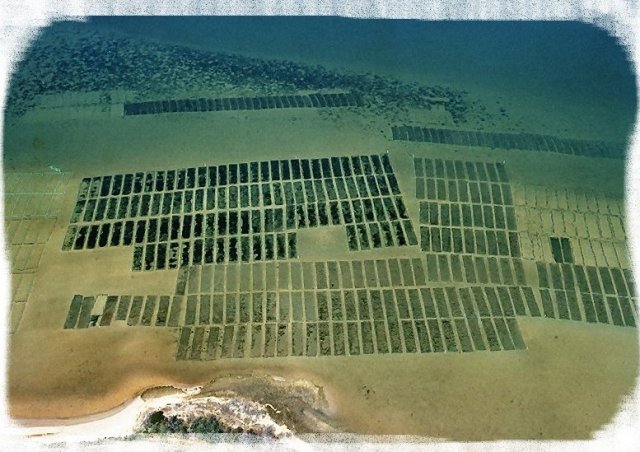
The Virginia Marine Resources Commission strongly encourages gardening and farming of oysters and clams.
These shellfish provide important economic and environmental benefits. In fact, a single adult oyster can purge 50 gallons of water a day! And shellfish gardening and farming reduce harvest pressure on wild stocks, while increasing the overall number of shellfish that help clean the water and serve as habitat for fish and crabs.
Clam and oyster farming, also known as aquaculture, is a booming, multi-million dollar industry in Virginia. Oyster gardening under private piers and along the shoreline of privately owned waterfront property is becoming increasingly popular among environmentally concerned citizens.
In most cases, permits and/or licenses are necessary to set up shellfish gardens or farms. This is to help us ensure fair use of the public water bottoms, reduce potential user conflicts, head off navigation issues, limit the chance contaminated shellfish are mistakenly taken from condemned waterways, and preserve underwater grasses that shelter juvenile fish and crabs from predators.
Our permitting system is formulated around three factors: Do you intend to sell the shellfish you grow? Do you intend to grow shellfish in floats or in cages resting on the bottom? Do you intend to grow shellfish on water bottoms you lease from the state?
The Department of Health’s Shellfish Sanitation Division identifies both seasonally and permanently condemned waterways. Maps of those condemned areas can be found at: https://www.vdh.state.va.us/EnvironmentalHealth/Shellfish/closureSurvey/index.htm
If you wish to grow shellfish not for sale at your pier in either floats or cages in the riparian area of the shoreline of your waterfront property (not to exceed 160 square feet in area), you must obtain an oyster gardening permit (General Permit #3) from our Habitat Management Division. There is no cost for this permit. Regulations and requirements for this activity are found at: oyster gardening regulations and permit form.
Additionally, if you own upland with a minimum of 205 linear feet along a tidal waterway, you may qualify for a riparian oyster ground lease. More information related to applying for this type of lease may be obtained from the Engineering/Surveying Department (757-247-2225).
If you wish to grow shellfish for sale in cages that extend no more than 12 inches off the bottom on a regular oyster ground lease obtained from the state, you may do so under Habitat Management regulation 4VAC20-335-10.
Placement of cages under this regulation must be marked properly with corner markers and signage. In conjunction with the on-bottom regulation, the regulation for marking requirements can be found here https://www.mrc.virginia.gov/regulations/fr290.shtm. Examples of approved signage can be found here. Contact the Engineering/Surveying Department for additional assistance on alternative verbiage for approved signage.
If you have a regular oyster ground lease from the state and wish to grow shellfish in cages or containers greater than 12-inches above the bottomlands and/or to be marked on the surface with buoys, you will need a General Permit #4 from our Habitat Management Division under regulations and requirements found here: https://www.mrc.virginia.gov/regulations/fr1130.shtm. For the General Permit # 4, a Joint Permit Application form should be completed and submitted to the Habitat Management Division.
If you wish to grow shellfish for sale in floating cages on the surface above state-owned subaqueous bottomlands, whether you have an oyster ground lease or not, you will need to submit a Joint Permit Application, with a detailed plan of the operation, to our Habitat Management Division. Additionally, a request to place cage structures upon state-owned subaqueous bottomlands, without an oyster ground lease, also requires the submission of a Joint Permit Application, with a detailed plan of the operation to our Habitat Management Division. Details can be found at the VMRC web site home page at the Habitat Permits link at https://www.mrc.virginia.gov/forms/index.shtm.
If you have questions on what permit you may require, please contact Adam Kenyon of our Engineering/Surveying Department for assistance. He can be reached at 757-247-2225 or at Adam.Kenyon@mrc.virginia.gov.
If you are interested in how to obtain a new shellfish lease contact Adam Kenyon above. Note also that the Commission has the following web page that lists individuals that are interested in obtaining or selling a shellfish lease using the lease transfer process: Leases for Sale. You can find a list of pending shellfish lease applications and associated locations: Pending Oyster Lease Applications.
Prior to harvesting aquaculture products from an assigned lease, the leaseholder must first pay the Aquaculture User Fee and obtain an Aquaculture Product Owners License. Individuals that are granted permission from the leaseholder to harvest aquaculture products from an assigned lease must first obtain an Aquaculture Harvester Permit. There are fees associated with the permits, licenses and user fee described above.
If Aquaculture products are harvested by a dredge or hand scrape, the harvester must first obtain a dredge permit from the area Marine Police Officer assigned to that specific district. There is no charge for the dredge permit and Commercial Gear license is NOT required for the harvest aquaculture products.
Aquaculture Product Owners and/or harvesters are required to report any harvest through the Fisheries Management Division’s Mandatory Harvest Reporting Program. Regulations and requirements for mandatory harvest reporting can be found at: https://mrc.virginia.gov/regulations/FR610.shtm.
Before any shellfish licenses and/or permits can be issued, mandatory Shellfish Harvester Safety Training is required of both product owners and/or harvesters. Information concerning this training is shown below:
PRODUCT OWNERS/HARVESTERS - Training is required prior to purchasing VMRC shellfish licenses and permits. The training can be completed online and is valid for 5 years. Training is free and takes approximately 45 minutes — 1 hour.
Online link : https://webapps.mrc.virginia.gov/public/training/register.php
For those product owners/harvesters who do not yet have a VMRC ID number to use for the online training:
STEP 1. Contact VMRC main office [(757) 247-2120] to receive a VMRC ID number.
STEP 2. Use this VMRC ID number to complete the mandatory online harvester course.
STEP 3. Upon completion of the course, proceed to a local agent to purchase the permit.
If you have questions about mandatory reporting requirements, please contact Stephanie Iverson of our Plans and Statistics Department at (757-247-2061 or at stephanie.iverson@mrc.virginia.gov).
Page updated: 01:32 PM Wednesday, August 2, 2023